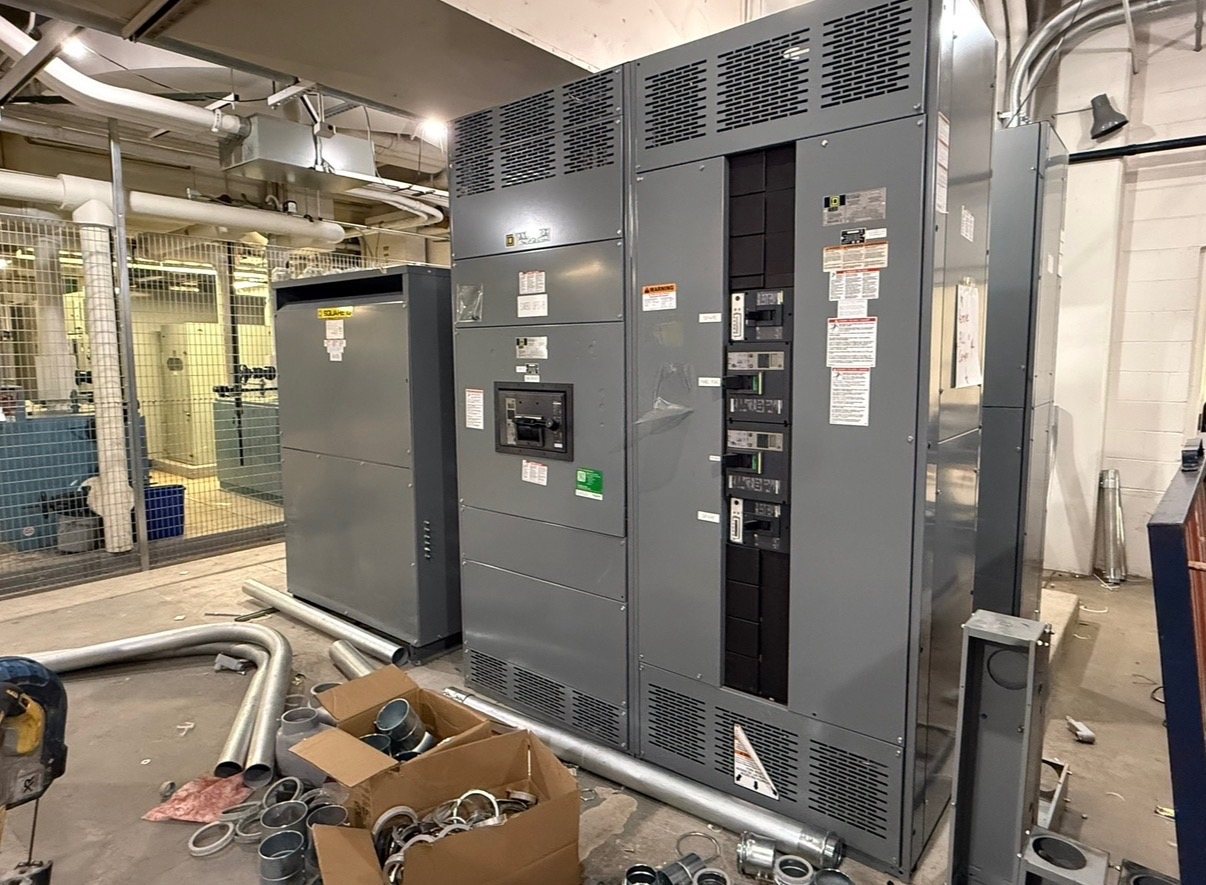
Start with the assembly identity and nameplate scope
First establish which equipment the plate identifies. A nameplate may apply to an entire switchboard or switchgear assembly, while individual sections, devices or components can carry separate identification and ratings. Record the manufacturer, catalog or assembly identifier, serial or reference number, and any section designation shown. Compare those details with the project drawings and equipment schedule before treating a rating as applicable to the whole lineup.
Do not assume that a plate on one cabinet covers adjacent equipment, a later modification or every device installed in the assembly. Check whether the information belongs to the original assembly, a replacement section, or a specific retrofit component. For a replacement project, provide clear photographs of the complete nameplate and relevant component labels, along with drawings and dimensions. This helps us scope new equipment or new retrofit components accurately.
Read voltage and frequency as system requirements
The voltage marking describes the electrical system or equipment voltage associated with the assembly. Read the full value and any accompanying phase, wire or system notation rather than relying on a single number. Compare the nameplate with the one-line diagram, service information and connected equipment requirements. A mismatch can affect equipment selection, insulation coordination and the suitability of devices within the assembly; do not infer compatibility from physical appearance alone.
Frequency is commonly marked in hertz and should be checked against the intended power system. If the nameplate lists more than one voltage or frequency condition, identify which condition applies to the project and which devices are included. When requesting pricing, share the required system voltage, frequency, phase and configuration, plus the existing plate information if replacing equipment. Availability and engineering suitability are confirmed for the quoted design, not inferred from a generic nameplate example.
Interpret continuous current without overreading it
Continuous current indicates the current the assembly or a designated part is rated to carry under stated conditions. Note whether the value is identified as an assembly rating, bus rating, main rating or device rating; these are not automatically interchangeable. If several current values appear, match each to its labeled section or component. The project load and protection design must be assessed against the applicable ratings by qualified engineering personnel.
A nameplate current value alone does not establish that an assembly suits every load profile or future expansion. Ask what rating applies to the incoming section, distribution bus and relevant feeder positions, and whether the drawings show the same arrangement. For a new build or retrofit request, provide the required continuous current and the intended section layout. We review the specified configuration and components for the quotation rather than treating a single marked value as a complete design approval.
Distinguish short-circuit ratings and conditions
Short-circuit information may be expressed as an interrupting rating for a device, a short-circuit current rating for an assembly, or a withstand rating tied to a stated duration. These terms describe different capabilities. Record the exact wording, current value, time basis and any conditions or notes on the plate. Do not substitute a breaker rating for an assembly rating or assume that a value applies to every combination of devices and bus components.
The available fault current and protective-device coordination are project-specific engineering inputs. Compare the marked rating with the study, one-line diagram and specified upstream protection, and have discrepancies reviewed before procurement. If the existing label is unclear, provide an unobstructed photograph and the relevant drawings rather than guessing at a digit. The required short-circuit performance must be stated for new equipment or retrofit components and confirmed for the proposed configuration.
Use enclosure markings to understand construction
The enclosure description or type marking communicates construction and environmental protection characteristics, but its meaning depends on the applicable standard and exact designation. Transcribe the full marking, including any suffix, and compare it with the installation location and project requirements. Do not treat a general description such as indoor or outdoor as a substitute for the marked enclosure classification or a review of site conditions.
Document the mounting arrangement, access needs, cable entry direction, space constraints and exposure conditions alongside the nameplate details. These factors can affect the enclosure configuration and retrofit fit, even when electrical ratings appear similar. For a quotation, provide overall dimensions, section arrangement, connection information and photos where available. We assess the requested construction for new equipment; actual dimensions, options and suitability must be confirmed during project review.
Verify manufacturer, standards and listing information
The manufacturer name identifies the party associated with the labeled assembly; model, serial and date information, when present, can help distinguish its configuration and records. Standards references and listing marks should be read exactly as printed, including the scope to which they apply. UL 891 is a standard for switchboards, not a blanket listing for all switchgear. A standards reference alone does not establish that a particular assembly is listed.
For a new specification or replacement, identify the required standard, listing scope and documentation in the procurement documents. Listing and applicable standards should be verified for the proposed configuration; do not assume an existing mark transfers to modified equipment or a new assembly. We manufacture new equipment and supply new retrofit components only. Component origin, engineering, availability, lead time and test documentation are reviewed and confirmed for each quotation.