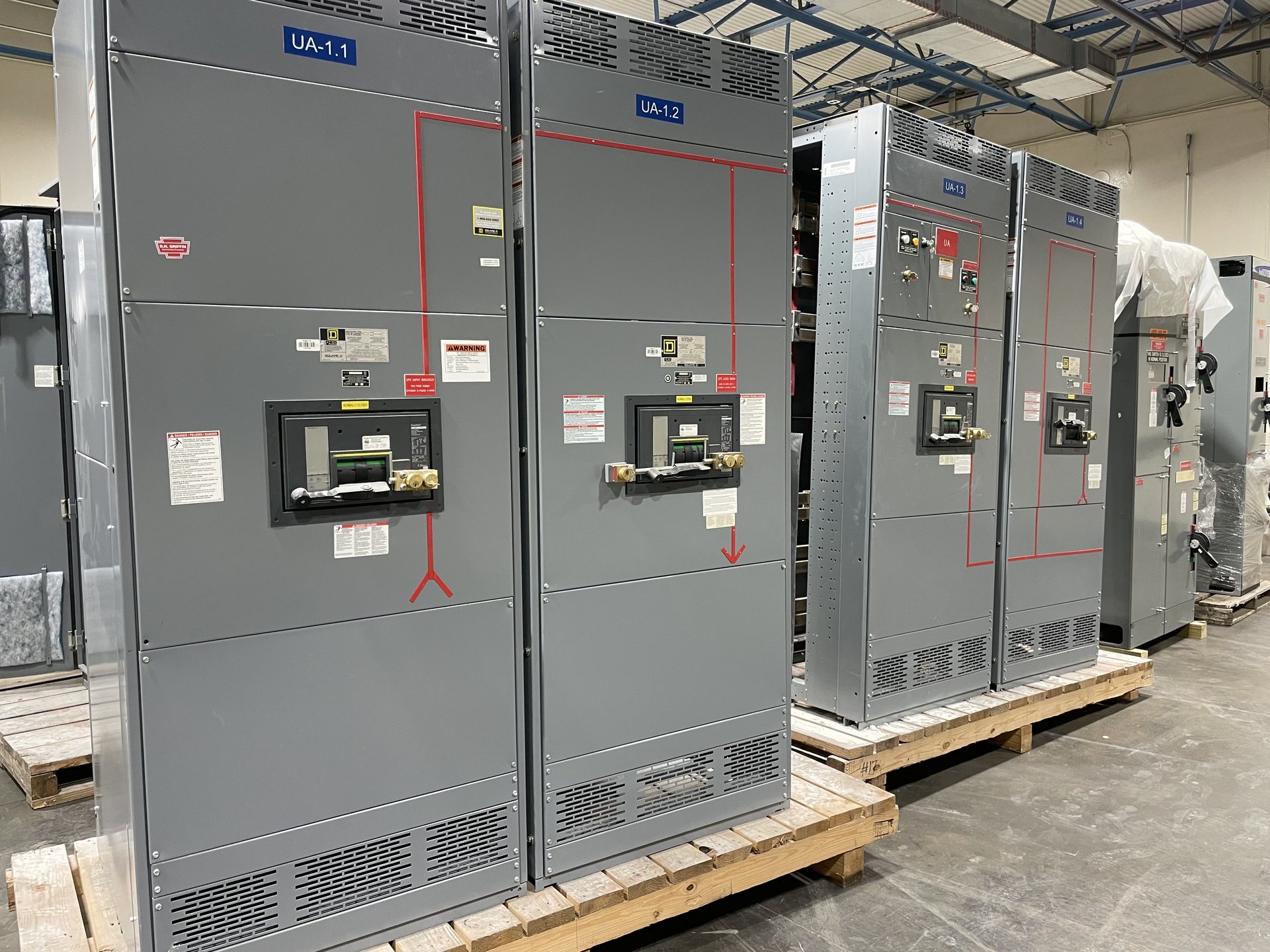
Eleven industries, eleven different design contexts
For healthcare, data centers, manufacturing, oil and gas, water and wastewater, commercial buildings, education, transportation, renewable energy, telecommunications, and food and beverage facilities, the electrical one-line is only a starting point. Each application has a distinct mix of normal and critical loads, operating schedules, environmental exposure, and consequences of an interruption. Those differences affect the required distribution arrangement, protective devices, controls, enclosure, and equipment interfaces.
Start by identifying what the switchgear serves, which loads must remain available, and what happens when a source or section is unavailable. Then document source characteristics, load types, expansion plans, fault-current information, operating modes, and site conditions. These inputs let the project team compare practical configurations without assuming one industry label dictates a standard design. Equipment selection, component origin, documentation, and lead time are confirmed during quotation review.
Healthcare and data centers: define continuity by load
Healthcare facilities need clear separation and coordination for normal, essential, and other designated loads according to the project’s applicable codes and design documents. Identify the sources serving each group, transfer or bypass interfaces, generator connection points, and the loads that cannot tolerate an interruption. Patient-care areas, imaging equipment, laboratories, and building services may have different operational priorities; the distribution specification should reflect the facility engineer’s documented sequence of operation.
Data centers require a similarly explicit account of availability, but the critical issue is the complete power path to each IT and cooling load. Document utility and backup sources, bus or section arrangements, maintenance isolation needs, monitoring points, and connections to downstream UPS equipment. Ask whether planned maintenance or a component failure must leave a particular path in service. The selected topology and protection must be reviewed as a coordinated system, not as a switchgear feature in isolation.
Manufacturing and oil and gas: match equipment to process loads
Manufacturing plants often combine large motors, variable-frequency drives, process controls, heating loads, and general building distribution. Gather motor starting methods and duty, drive input characteristics, expected simultaneous demand, critical process groups, and future line additions. Determine which loads may be shed and what operating sequence should follow a source transfer or protective trip. Coordination with motor-control equipment and downstream panels is essential to avoid specifying a distribution assembly without its real interface requirements.
Oil and gas facilities can involve remote or unmanned operation, outdoor exposure, vibration, corrosive atmospheres, and process loads with distinct shutdown consequences. The project team should establish the installation environment, hazardous-area boundaries where applicable, cable entry and termination needs, control and communications interfaces, and required remote status or trip signals. Define source arrangements and process isolation expectations with the responsible electrical and process engineers. Enclosure and protection choices must be based on documented site conditions, not a broad industry assumption.
Water, commercial, and education facilities: account for operating conditions
Water and wastewater systems commonly serve pumps, blowers, treatment equipment, and control systems whose demand varies with process conditions. Document motor sizes and starting characteristics, duty cycles, standby equipment, alarm and supervisory connections, and the loads required during an outage. Outdoor stations may need different enclosure and environmental provisions than an indoor treatment building. Confirm how the switchgear will coordinate with motor controls, backup generation, and supervisory control systems before finalizing the equipment scope.
Commercial buildings and education campuses usually combine tenant or classroom distribution with HVAC, elevators, lighting, life-safety interfaces, and other shared services. Identify metering boundaries, planned tenant changes, emergency source connections, operating schedules, and the facility’s maintenance access constraints. A campus may have multiple buildings or distribution stages, so define the switchgear’s upstream source and downstream boundaries precisely. For both sectors, record room dimensions, access routes, cable approach, and expansion expectations to support a workable equipment arrangement.
Transportation and telecommunications: specify interfaces and resilience
Transportation facilities can serve stations, depots, terminals, signaling support, lighting, ventilation, and operational technology. Their specifications should distinguish public-facing building loads from systems tied to safe or continuous operations, then define source redundancy, transfer logic, monitoring, and connections to control or communications equipment. Consider vibration, dust, moisture, and access restrictions associated with the installation location. Confirm who owns each interface and what status, alarm, or interlock signals must pass between switchgear and the wider system.
Telecommunications sites and network facilities often have concentrated, sensitive electronic loads and limited tolerance for service disruption. Clarify the relationship between utility service, backup generation, UPS systems, rectifiers, cooling, and the distribution equipment at the point of use. Document load growth, remote monitoring requirements, grounding and bonding criteria from the project design, and any site limitations affecting enclosure or cable routing. Specify how alarms and operating states reach the network or building management system, and who supplies each connection.
Renewable energy and food and beverage: address specialized duty
Renewable energy projects require switchgear interfaces to be defined around the actual electrical architecture. Identify whether the equipment serves collection, auxiliary loads, a facility interconnection, or another portion of the system; document source and load characteristics, protection functions, metering, control signals, and the boundaries with transformers, inverters, and utility equipment. Utility interconnection requirements and project studies govern the final design. Voltage and current requirements are project parameters, and the proposed configuration must be reviewed for suitability before quotation.
Food and beverage facilities may combine refrigeration, pumps, packaging lines, process heating, washdown areas, and sanitation schedules. Document which processes must remain available, equipment starting and cycling behavior, cleaning exposure, ambient conditions, and any enclosure or corrosion considerations. Establish the required interfaces with process controls, motor controls, emergency sources, and facility monitoring. Equipment materials and construction should follow the project’s stated environment and maintenance practices; do not assume a generic enclosure or protection approach fits every production area.
Specify new equipment and retrofit components with a complete package
For a new assembly, provide the one-line diagram, load and source data, available fault-current information, protection and coordination criteria, control schematics, metering needs, enclosure and room constraints, cable details, and applicable standards. For a retrofit, identify the existing assembly and interface dimensions, electrical ratings, bus and connection details, protective-device requirements, and the operational limits of the planned outage. We supply new equipment and new retrofit components only; compatibility and scope require engineering review before pricing.
Include the requested component origin, submittal requirements, inspection or test documentation, shipping destination, and project schedule in the inquiry. Specify American components when required by the project, and identify any domestic-content terms for review; origin and compliance documentation must be confirmed for the quoted configuration. UL 891 applies to switchboards, not every type of switchgear, so verify applicable standards and listing requirements for the specific assembly. Installation, service, testing, and energization belong to qualified personnel working under approved procedures.