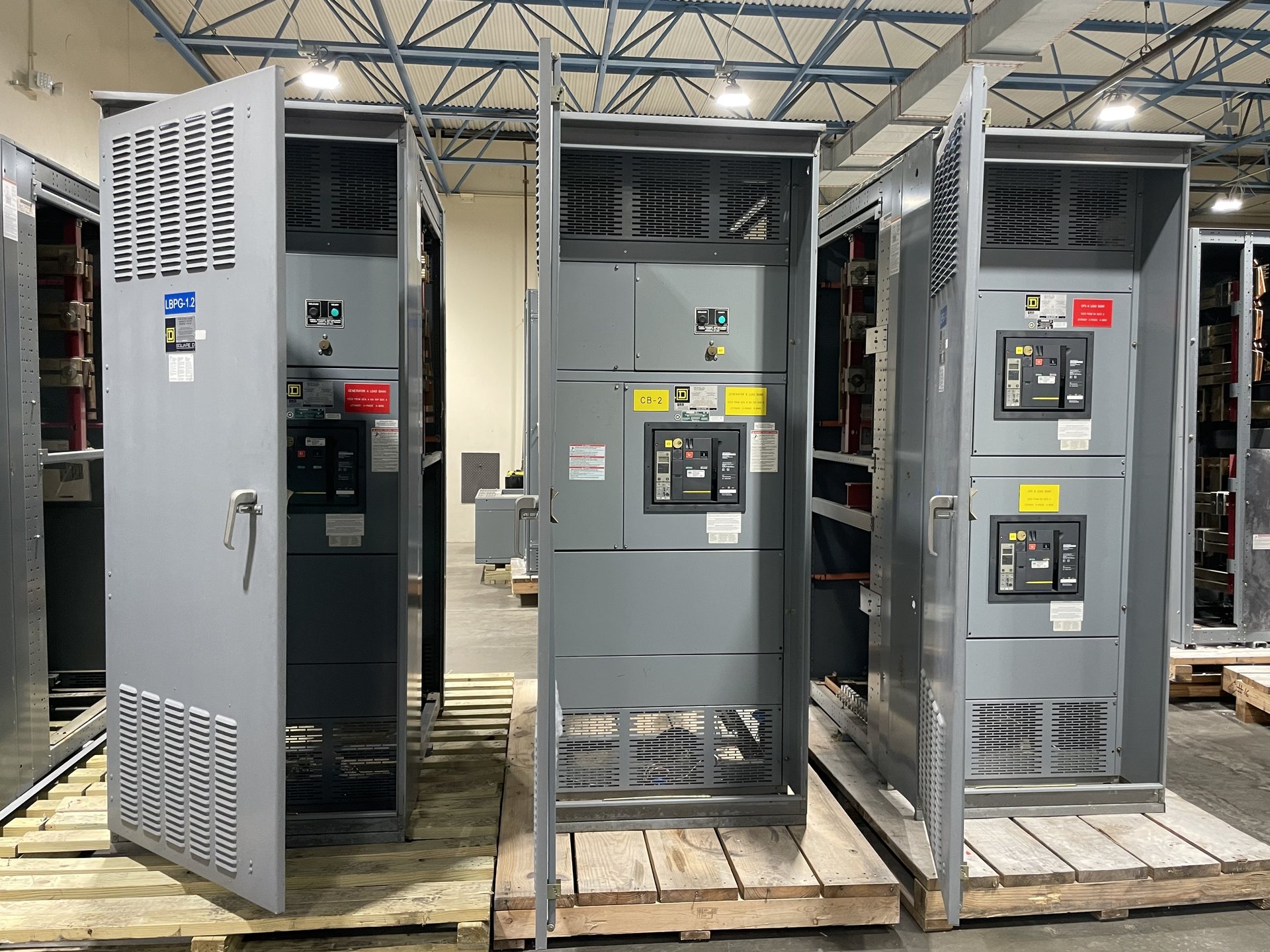
Select Bus and Breakers Around the One-Line Diagram
For a Lubbock project, start bus selection with the system arrangement and the load profile—not a catalog assumption. Identify the incoming source, bus sections, ties, feeders, and expected load growth. Confirm the specified bus material and rating, phase and neutral arrangement, and any grounding-bus requirements. These choices affect the assembly layout and must align with the electrical design and the way the distribution system is intended to operate.
Breaker selection should follow the feeder schedule and the protective-device requirements. Provide breaker type, frame and trip requirements where established, pole count, accessory needs, and the connected load or equipment served. Clarify whether the design calls for fixed or drawout construction and how spare or future positions should be handled. We build new equipment and new retrofit components to specification; suitability and availability are confirmed during project review.
Document Available Fault Current at the Equipment
Available fault current is a key input for evaluating low-voltage switchgear. Ask the electrical engineer to provide the calculated value at the equipment location and the assumptions used for the calculation, including relevant source and transformer information. The specified assembly and breakers must be evaluated against the project’s fault-current requirements. Do not treat a nominal system voltage or an upstream device rating as a substitute for the documented value at the gear.
The quotation review should identify the required interrupting and assembly withstand or short-circuit ratings as applicable to the specified configuration. Also provide the protective-device and system coordination criteria, since device selection and settings influence how the design responds to faults. If calculations or source details are incomplete, resolve those gaps with the responsible engineer before equipment selection is finalized. Ratings, engineering, and supporting documentation are confirmed for each quoted configuration.
Match the Enclosure to the Installation Environment
Describe where the equipment will be installed and the conditions it must accommodate. Relevant details include indoor or outdoor placement, exposure to weather or washdown, dust, corrosive agents, ambient conditions, ventilation, and room constraints. State the required enclosure construction and environmental protection in the project documents rather than relying on a general location description. Lubbock is the project destination; the actual installation environment—not the city name alone—should govern enclosure selection.
Room access and operating conditions also affect the practical layout. Share equipment-room dimensions, clearances established by the design, cable-entry direction, conduit or busway approach, and any barriers or access restrictions shown on the plans. Identify heat or ventilation constraints and whether doors must open into a particular space. We review these requirements with the specified arrangement; final fit, clearances, and installation compliance remain subject to the project design and qualified installation review.
Coordinate Equipment With Installation Drawings
A coordinated drawing package reduces the risk of a mismatch between the quoted assembly and the field installation. Provide the latest one-line diagram, elevations, floor plan, conduit and cable-entry information, feeder schedule, and control schematics where applicable. Mark drawing revisions and identify which documents govern if details conflict. Include equipment tags and section designations consistently so the quotation and subsequent submittal review can be tied to the intended lineup.
Compare the proposed arrangement with the installation drawings for section sequence, dimensions, access, termination space, and connection orientation. Confirm incoming and outgoing cable directions, busway interfaces, tie locations, and any transition or splice requirements. Changes to the room layout or electrical design after review should be communicated before fabrication planning. Project-specific drawings, dimensions, and submittal information are confirmed during quotation and engineering review, rather than assumed from a general product description.
Plan New Retrofit Components Around Existing Gear
Where a Lubbock project involves an existing lineup, provide clear identification of the installed equipment and the exact component being replaced or added. Useful records include manufacturer and catalog information, nameplate details, section and position identifiers, breaker data, bus arrangement, and photographs of labels and interfaces. New retrofit components require careful compatibility review; physical fit alone does not establish electrical suitability or compatibility with the existing assembly.
Share the existing one-line diagram, prior modifications, and available drawings, and identify the reason for the retrofit—such as a changed load, a replacement need, or a planned expansion. Confirm the required ratings, connection style, accessory functions, and any project limits on outages or equipment changes. We supply new retrofit components. Compatibility, engineering scope, component availability, and documentation must be evaluated for the specific existing gear and project conditions.
Prepare a Complete Request for Pricing
A useful pricing request identifies the project location in Lubbock, service voltage, system configuration, bus requirements, breaker schedule, available fault current, enclosure conditions, and required options. Attach the current drawings and specifications, note drawing revisions, and state the requested equipment scope, including whether it is a new lineup or new retrofit components. If a requirement is not yet established, label it as open rather than allowing an assumption to become a design constraint.
Also request confirmation of the proposed scope, exceptions, required submittal documents, and schedule basis for the particular project. Lead time, engineering, component origin, availability, and test documentation are subject to review and confirmation with each quotation. If domestic components are specified, list that requirement clearly; do not assume every component meets a particular domestic-content rule without project-specific confirmation. Installation, servicing, testing, and energization must be performed by qualified personnel under approved procedures. Listing and applicable standards should be verified for the quoted configuration; UL 891 applies to switchboards, not universally to all switchgear.