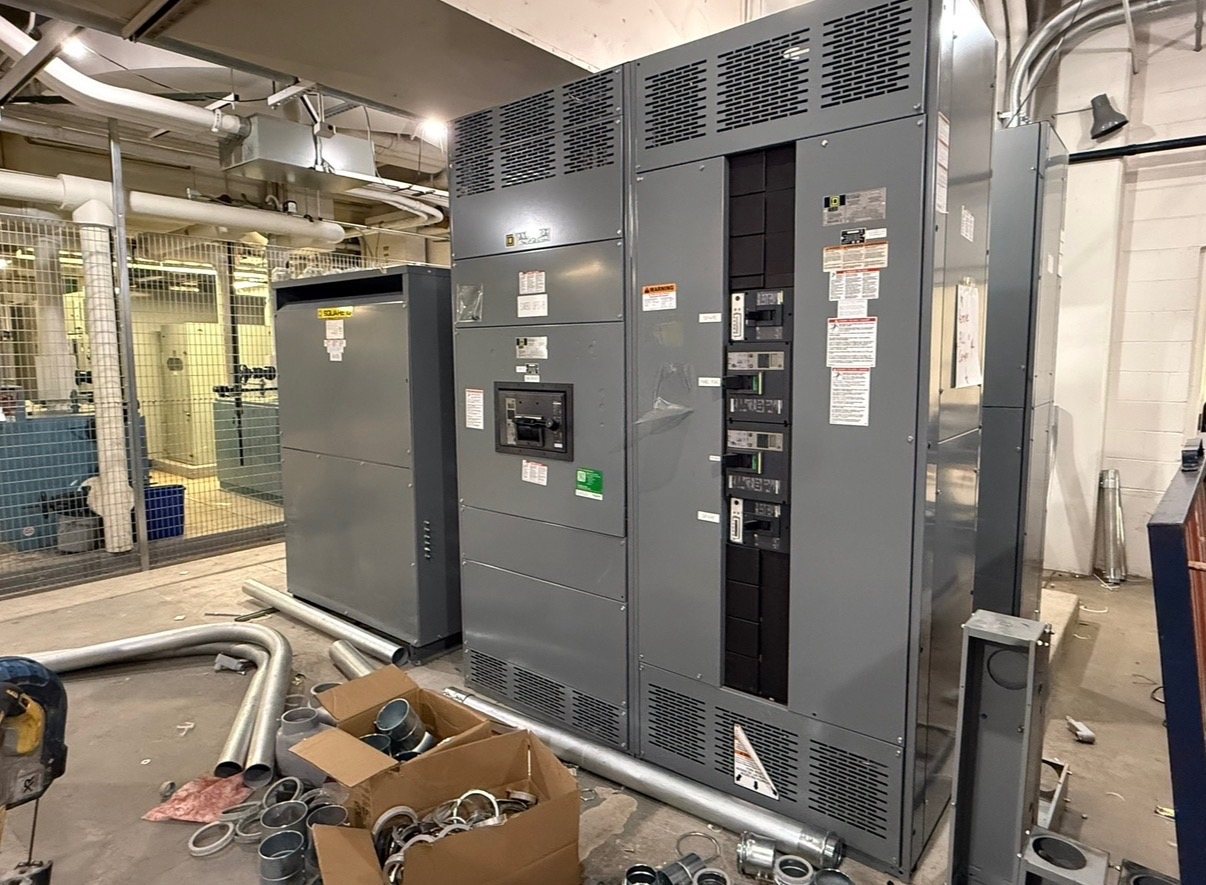
Survey the Existing Switchgear Before Defining the Retrofit
A useful retrofit scope starts with reliable records of the installed lineup, not a general description such as “replace the switchgear.” For a Midland facility, gather equipment nameplates, one-line diagrams, control schematics, manufacturer and model details, bus arrangement, enclosure dimensions, cable entry locations, and available maintenance records. Photographs should show the full lineup and relevant connections, while field measurements should be taken by qualified personnel under approved site procedures.
The survey should also identify the equipment’s role in the distribution system and any site constraints that could affect replacement. Record the source and downstream loads, available access and rigging paths, room clearances, environmental conditions, and operating schedule. Note undocumented modifications or differences between drawings and installed equipment. These details help us determine what further engineering information is needed before defining new equipment or retrofit components for pricing.
Check Replacement Compatibility at the Interface
Physical fit is only one part of replacement compatibility. Compare the existing lineup’s footprint, mounting and anchoring provisions, bus connections, cable and conduit approaches, door and compartment arrangement, and required clearances with the proposed configuration. A replacement that fits the available room may still require changes to conductors, supports, terminations, or adjacent equipment. Identify which interfaces must remain unchanged and which can be redesigned as part of the project.
Electrical and control interfaces deserve the same attention. Document breaker or switching-device functions, auxiliary contacts, interlocks, metering, protective relays, control voltage, communications needs, and external trip or alarm signals where applicable. Confirm the intended operating sequence with the responsible engineer and facility team. We use these project inputs to develop new equipment or new retrofit components to specification; compatibility and the extent of required modifications must be evaluated for the particular installation.
Reconcile Bus Ratings and Available Fault Current
Bus requirements should be established from the system design and equipment documentation, rather than inferred from enclosure size or an old nameplate alone. Confirm the required continuous-current capacity, bus arrangement, connection details, and any temperature or installation conditions relevant to the design. Where a retrofit interfaces with retained equipment, the ratings and physical characteristics of both sides of the connection must be considered together to determine whether the interface is suitable.
Fault-duty review is equally important. The responsible engineer should establish available fault current at the equipment location and assess the required short-circuit withstand or interrupting ratings for the selected configuration and protective devices. Changes to utility sources, transformers, generators, or system impedance can affect that assessment. Provide current one-line diagrams and applicable fault-study information with the request for pricing. Ratings, component selection, and applicable standards are confirmed during project review; they are not assumed from a general product description.
Sequence Outages Around Operational Constraints
Modernization planning should identify which loads can be interrupted, for how long, and in what order. For Midland sites with continuous processes, critical building systems, or multiple distribution sections, map the dependencies between incoming sources, buses, feeders, and backup supplies before setting an outage window. Clarify whether temporary power, load transfers, staged replacement, or a single planned shutdown is being considered, and who has authority to approve each operating change.
A workable sequence also depends on equipment delivery, site readiness, permits, access, and the availability of qualified installation personnel. Align the proposed work plan with facility operations, the electrical contractor, the engineer of record, and any other parties responsible for switching or construction. We can review the equipment scope and requested schedule for a quotation, but project-specific lead time and delivery timing require confirmation. Installation, testing, and energization must follow approved procedures and be performed by qualified personnel.
Coordinate Field Installation and Existing Connections
Before new equipment arrives, the project team should define responsibility for removal, handling, rigging, anchoring, connections, and restoration of affected systems. Verify room dimensions, access routes, floor and structural requirements, cable lengths, termination space, and the condition of existing conductors. Confirm whether field changes to supports, conduit, grounding, or adjacent sections are in scope. Clear responsibility boundaries reduce the risk of discovering an unplanned interface issue during the outage.
For a replacement or retrofit-component scope, agree on the field information needed to verify fit and connection details, along with the documents required for installation planning. Typical project records may include approved drawings, connection details, equipment schedules, and applicable component documentation, as confirmed for the quoted configuration. The contractor and site team should coordinate hold points and inspection responsibilities before work begins. We supply new equipment and new retrofit components; we do not represent field installation as included unless the quotation expressly defines it.
Prepare a Complete Request for Pricing
A focused pricing request should describe the existing lineup, the intended modernization outcome, and what must remain in service or unchanged. Include equipment identification, drawings, survey photographs, bus and fault-duty requirements, preferred arrangement, interface constraints, control and metering needs, and the target outage period. Identify known discrepancies in records and list open engineering questions instead of treating uncertain values as confirmed requirements.
State the requested documentation, component preferences, delivery destination in Midland, and any project-specific standards or procurement conditions. If American components are required, identify that preference in the request so it can be reviewed for the proposed configuration; component origin and any applicable documentation must be confirmed for each quotation. Availability, engineering scope, lead time, and applicable standards are also subject to project review. UL 891 applies to switchboards, not every type of switchgear, so verify the relevant standard and any listing requirements for the specific assembly.