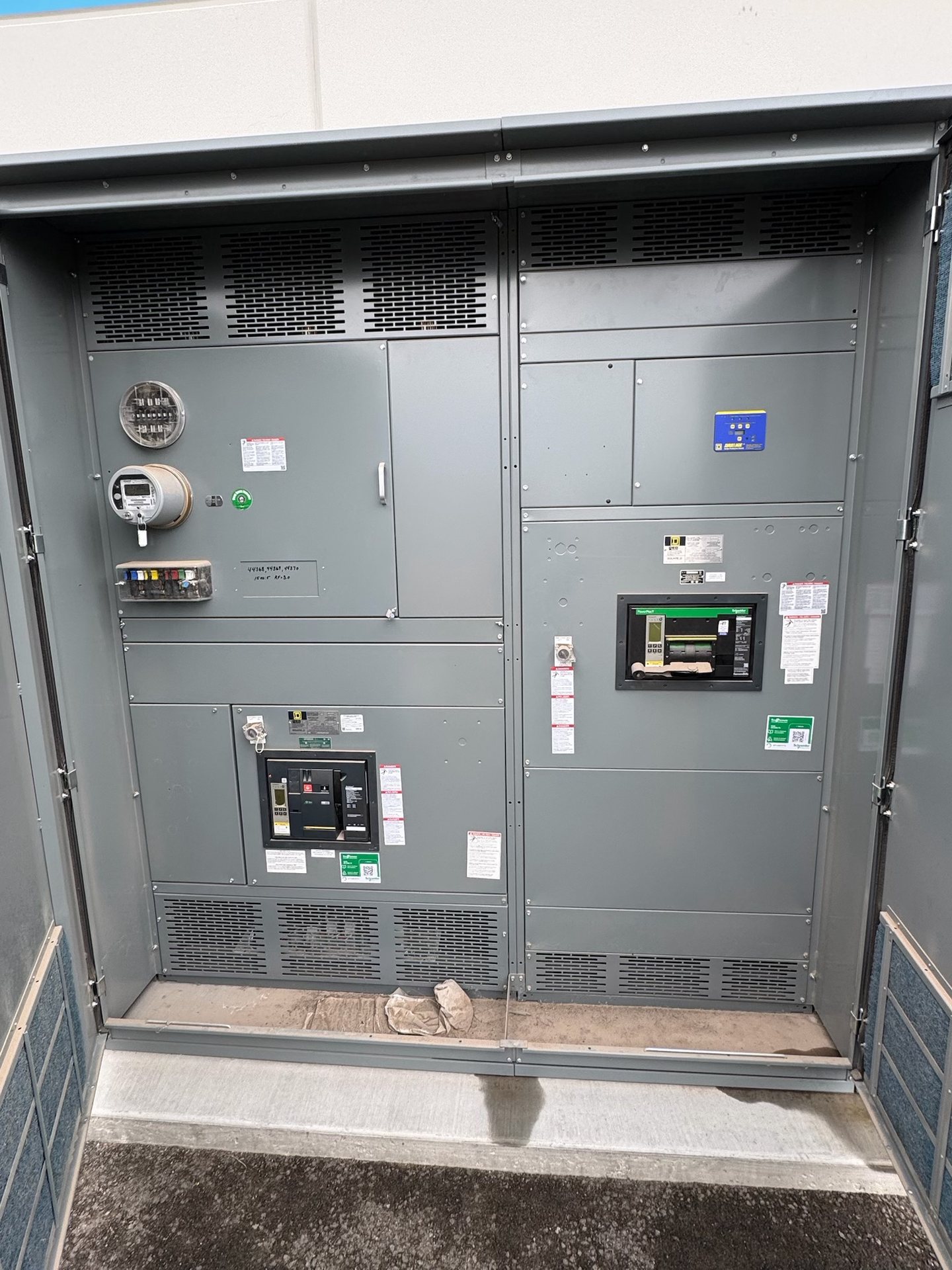
Define the Utility-to-Distribution Boundary
Start by identifying where utility ownership and operating authority end and the customer’s equipment begins. That point may be at incoming cable terminations, a utility metering compartment, or another location defined by the serving utility. The one-line diagram, utility service requirements, and project specifications should agree on the boundary, including who supplies, installs, inspects, and maintains each item.
Before equipment is selected, ask the utility and engineer to confirm required compartment access, barriers, seals, grounding provisions, and any restrictions on customer access to utility-controlled spaces. Identify the party responsible for reviewing drawings and accepting the interface. These answers determine compartment arrangement and documentation needs; they should not be inferred from another project or a generic switchgear layout.
Resolve Incoming Cable and Termination Details
Incoming-cable compatibility depends on more than nominal voltage. Provide the cable type, conductor material, size and quantity per phase, insulation and shield details, number of runs, and whether the approach is from above or below. The engineer should also identify termination style, bending-space constraints, grounding method, and any transition between utility cable and the equipment bus.
Confirm these details against the utility’s current construction standards and the project cable schedule before requesting a quotation. Ask whether the utility requires particular termination locations, clearances, or provisions for future conductors. The equipment layout must accommodate the specified cables without assuming that a standard compartment will fit; final dimensions and cable-entry arrangements require project review.
Coordinate Metering Requirements and Access
Utility metering can affect the interface compartment, instrument-transformer arrangement, wiring routes, and access provisions. Obtain the utility’s metering specifications and clarify whether metering is at the service entrance, on the customer side, or integrated with another approved arrangement. The project team should establish who furnishes current and voltage transformers, meters, test switches, secondary wiring, and associated enclosures.
Ask whether the utility requires a particular compartment configuration, instrument-transformer ratio, polarity marking, wiring termination, or separation from customer equipment. Do not assume that metering requirements are the same across utilities or service locations. The quotation package should identify which metering components are included, which are utility-furnished, and which remain by others, with approval responsibility stated explicitly.
Select Medium-Voltage Ratings from System Data
Select medium-voltage equipment using the project’s actual system information, not a voltage label alone. Provide nominal and maximum system voltage, frequency, grounding method, available fault current, and the protective-device clearing assumptions used by the engineer. For generation projects, include the operating configurations that can change fault contribution or energize the interface from more than one source.
The engineer should confirm equipment voltage class, insulation and withstand requirements, continuous-current needs, interrupting capability, and short-time withstand duty for the specified application. Identify whether normal, standby, parallel, or islanded operation affects the design basis. These values are project parameters, not standard availability claims; ratings and configuration must be reviewed and confirmed for each quotation.
Establish Review, Approval, and Testing Responsibilities
Separate utility acceptance from the manufacturer’s engineering review and the project’s code, design, and inspection obligations. Ask who approves interface drawings, metering details, protection settings, and any deviations from utility standards, and at what design stage those approvals are required. Record review status and open comments so equipment is not released against unresolved interface assumptions.
Define the requested submittals and closeout records in the purchase specification. Depending on the configuration, these may include outline and connection drawings, equipment data, wiring information, and specified inspection or test documentation. Confirm what can be supplied with the quoted assembly rather than presuming a particular test result or document set. Installation, servicing, testing, and energization require qualified personnel following approved procedures.
Prepare a Complete Equipment and Retrofit Scope
A useful request for pricing includes the one-line diagram, utility service criteria, equipment schedule, site and cable-entry constraints, operating sequence, and the medium-voltage system data used for design. State required quantities, delivery destination, requested submittals, project milestones, and any constraints on dimensions or interfaces. Identify the specified component origin and applicable standards, while recognizing that origin and documentation must be confirmed for the quoted configuration.
For retrofit work, define the existing equipment manufacturer and model, nameplate data, compartment and connection dimensions, interface drawings, and the exact functions to be retained or changed. We supply new equipment and new retrofit components only; compatibility requires review of the existing installation and project documents. Include photographs or field measurements where available, and identify who will verify fit and complete installation under the project’s approved procedures.