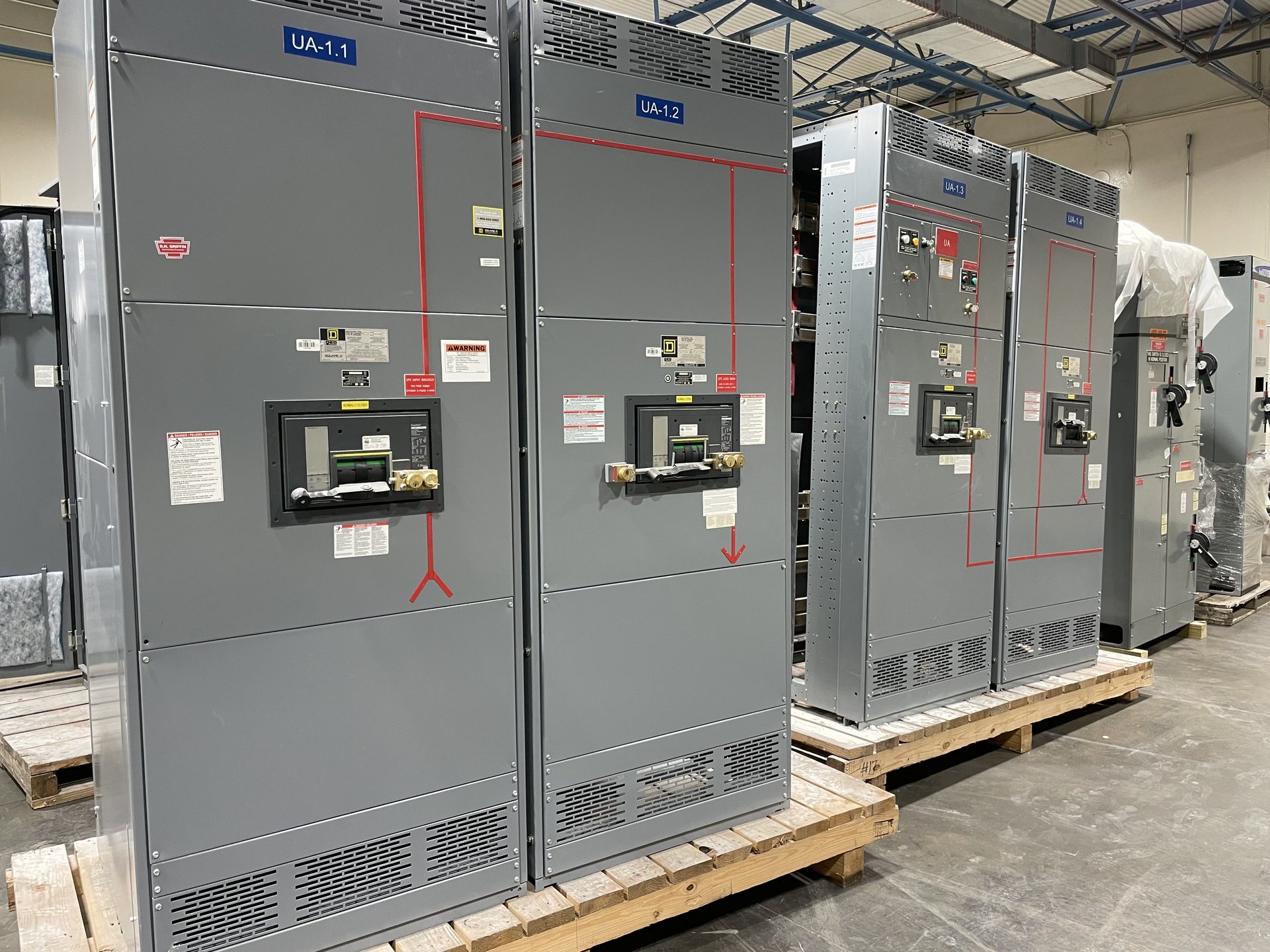
Choose the equipment class around its role
A 277/480 V three-phase, four-wire wye system commonly supplies 480 V line-to-line loads and 277 V line-to-neutral lighting loads. A switchboard may suit a facility’s main or distribution point when its service arrangement, protective-device class, and construction meet the project documents. Switchgear may be appropriate where the specified equipment arrangement, device selection, or operating and maintenance needs call for that class. A panelboard is generally considered for branch-circuit distribution rather than assumed to replace a service switchboard or switchgear.
Start the selection with a one-line diagram and identify the service entrance, transformer-fed sections, mains, feeders, branch circuits, and intended load connections. Ask whether the equipment must serve as the main disconnect, distribute power to downstream panels, or supply a defined set of loads. The answer determines the equipment class and configuration to evaluate. We build new equipment to the approved specification.
Match protective devices to the distribution duty
Protective-device class affects how an assembly is configured and how it coordinates with upstream and downstream devices. Document the required main and feeder device types, trip or fuse requirements, pole count, frame or ampere ratings, and any required adjustments or accessories. A device choice should follow the system study and design documents; it should not be inferred from the 277/480 V designation alone or copied from another voltage application.
For each protective device, request the information needed to review the proposed configuration against the one-line diagram and protection study. Confirm the intended source and load, equipment function, and coordination requirements with the project engineer. If the specification calls for particular device characteristics or an arrangement not yet shown on the drawings, resolve that gap before pricing. Device availability, engineering suitability, and supporting documentation are confirmed for each quotation.
Establish the short-circuit rating from the study
The equipment short-circuit rating must be evaluated against the available fault current at its point of installation and the protective scheme specified for the system. Provide the calculated available fault current, its location, and the study basis where available. Also identify upstream transformer data, source information, and any assumptions the engineer used. A nominal system voltage or an equipment class does not establish an adequate rating by itself.
Have the responsible engineer confirm that the specified assembly and its protective devices are suitable for the documented fault duty. Clarify whether the project requires a particular rating method or supporting documentation, and identify any constraints imposed by downstream equipment. Do not treat an assumed value as a final design input. The proposed configuration, applicable rating, and available documentation require project review before they can be confirmed in a quotation.
Plan working space and equipment access
Working-space requirements depend on the installation conditions, equipment arrangement, and applicable project and code requirements. Provide room plans, elevations, equipment orientation, adjacent walls or equipment, access routes, and the intended front, side, or rear access. Verify the required electrical working clearances with the project’s qualified design professionals and applicable authorities. A switchboard, switchgear lineup, or panelboard cannot be selected responsibly from voltage and circuit count alone.
Check how doors, covers, and removable components will open or be handled without obstructing required access. Record entry points for incoming and outgoing conductors, conduit locations, overhead obstructions, and the space available for installation and future service. If the room is constrained, identify the constraint in the request for pricing rather than relying on a field assumption. Final installation and maintenance must follow approved procedures and be performed by qualified personnel.
Compare maintainability over the equipment life
Maintainability is a selection criterion, not an afterthought. Compare the proposed equipment classes by access to protective devices and terminations, the ability to isolate sections as designed, and the space needed for inspection or component replacement. State whether the facility expects front-only access, how the equipment will be serviced, and whether continuity of other loads affects the required arrangement. These considerations can influence lineup layout and device configuration.
For an existing facility, provide the existing one-line diagram, equipment nameplate details, available photographs, and the reason for the change. Specify new equipment and new retrofit components only, and identify whether the work is a complete replacement or a defined retrofit scope. The replacement design must account for the existing system and interfaces; do not assume a new component will fit or function in an existing assembly without engineering review.
Prepare a complete specification for quotation
A useful pricing package includes the one-line diagram, load and feeder schedule, system study information, required protective-device details, fault-duty data, and room drawings. Note the source and service arrangement, conductor entry and exit preferences, enclosure and environmental requirements, and any project-specific standards. Identify the required drawings, submittals, and test documentation by name where the project documents specify them. Missing information should be clearly marked as pending so assumptions can be reviewed.
Send the package with the project location in Texas, required delivery destination, target schedule, and the decision date for submittal review. Lead time is subject to project review, engineering, and component availability; it should be confirmed with the quotation rather than assumed. We manufacture new equipment to specification using American components as specified by the customer. Component origin and any requested domestic-content documentation must be addressed and confirmed for the particular configuration.
Verify standards, listing, and submittal scope
Identify the standards and listing requirements that apply to the specific equipment class and installation. UL 891 applies to switchboards; it is not a blanket listing for all switchgear or panelboards. Do not infer a listing from a product category or from the system voltage. Ask for the applicable standards, listing status, and supporting documentation for the proposed configuration, and have the engineer and authority having jurisdiction review them against the project specification.
Before release, reconcile the approved submittals with the one-line diagram, schedules, protective-device requirements, fault-rating basis, room layout, and connection details. Confirm what documentation is included and which project-specific requirements remain open. Installation, servicing, testing, and energization require qualified personnel working under approved procedures. This final review helps ensure that the selected new assembly is evaluated as a complete system rather than as a voltage label or isolated device.