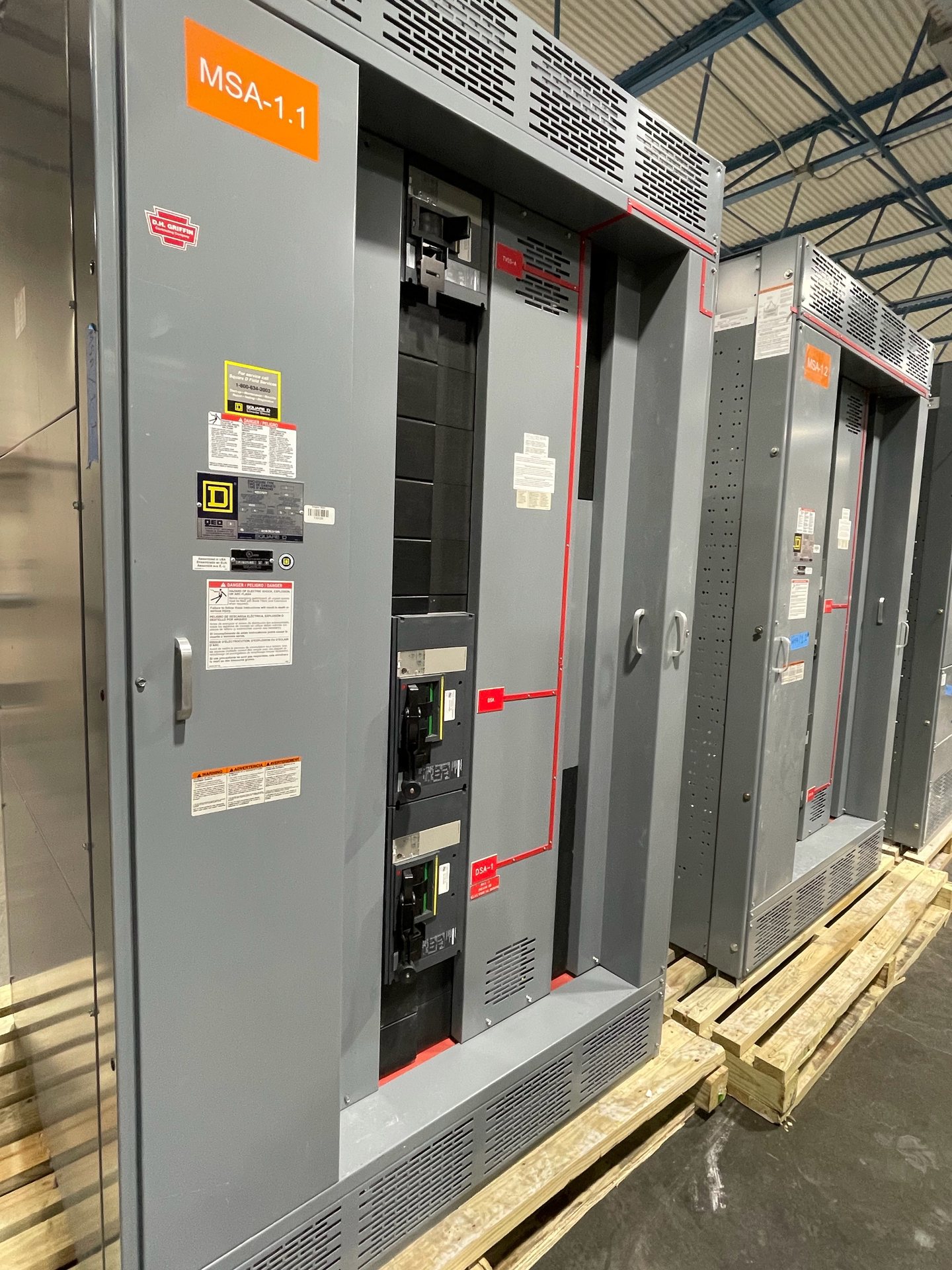
Plan the 800-Amp Section Layout
Begin by defining what the 800-amp rating represents in the project: the switchboard main rating, the bus rating, or both. Then establish the incoming source, service or distribution function, and outgoing circuits. These decisions determine the number and purpose of sections, the position of the main device, and how feeder devices can be arranged. A one-line diagram and equipment schedule give the manufacturer a sound basis for reviewing the proposed lineup.
Document the available installation width and height, working-space constraints, indoor or outdoor application, and the intended direction of cable entry and exit. Note whether the board must align with existing equipment or connect to a particular transformer, service, or downstream panel. For retrofit work, provide verified field dimensions and interface details rather than assuming a new assembly will match an existing footprint. We supply new switchboards and new retrofit components only.
Coordinate Main and Feeder Protection
The main protective device should be selected around the service arrangement, system voltage, load, and protection strategy. Clarify whether the design calls for a main breaker or another permitted main configuration, and identify any required trip functions or adjustment ranges. Feeder protection depends on each connected load and downstream equipment; provide circuit quantities, load descriptions, conductor information, and any known coordination requirements for engineering review.
Do not treat the 800-amp designation as a feeder-device schedule. Individual feeder ratings and device types must follow the project design and applicable requirements, with allowance for future circuits considered explicitly. If selective coordination, ground-fault protection, or integration with a monitoring system is required, identify that early and provide the relevant design criteria. Final device selection and compatibility must be confirmed for the quoted configuration.
Define Bus Capacity and Material
Specify the required bus arrangement and capacity, including the phases, neutral, and equipment grounding provisions applicable to the system. The bus design must coordinate with the switchboard rating and intended source and load connections; it should not be inferred from the main device alone. Provide system voltage, phase, wire configuration, and any project requirements for neutral capacity or grounding so the assembly can be evaluated against the one-line diagram.
Bus material and construction are also purchasing decisions. State the requested material and any project-specific requirements for plating, joints, or connection points, and ask for the proposed configuration to be identified in the quotation documents. If the board must connect to existing equipment, supply interface information and confirm how the bus arrangement will meet that connection need. Component origin and technical documentation are confirmed for each quotation; domestic-content compliance is not assumed.
Resolve Cable Terminations Before Release
Termination space can affect section dimensions, device placement, conductor routing, and installation access. Provide conductor material, quantity, size, insulation type where known, and whether conductors enter from above or below. Identify any required lug arrangement and whether the project calls for cable or bus connections. If conductors are parallel, list the number of sets and the routing constraints so connection provisions can be reviewed rather than left to field assumptions.
For replacement or expansion projects, document the existing conduit locations, cable lengths and approach, terminal orientation, and clearances that must be preserved. Confirm whether field modifications are prohibited or whether defined adaptation is part of the scope. The purchasing package should identify included connection provisions and any items supplied separately. Final terminations must be installed and checked by qualified personnel using approved project procedures; the assembly quotation does not replace installation planning.
Establish the Project Short-Circuit Rating
The required short-circuit rating must be based on the available fault current at the switchboard location and the system conditions used for the project. Provide the calculated or otherwise engineer-established value, the source and relevant transformer information, and any upstream protective-device details needed for evaluation. The 800-amp current rating does not establish a short-circuit rating, and no single fault rating should be presumed suitable for every installation.
Ask that the proposed assembly rating and its basis be documented for the quoted configuration. Where the design relies on a specific upstream device or a series-rated combination, provide that information for review and verify that the complete arrangement is acceptable to the project engineer and authority having jurisdiction. Applicable standards and any listing requirements must be checked for the specific configuration; UL 891 applies to switchboards and is not a blanket listing for every switchgear assembly.
Prepare a Complete Quotation and Submittal Package
A useful request for pricing includes the one-line diagram, equipment schedule, system voltage and phase, main and feeder requirements, bus specifications, conductor and termination data, available fault-current information, and enclosure or environmental requirements. Include the delivery destination, requested project milestones, and any required submittal format. This information helps us review scope and availability before confirming engineering, lead time, component origin, and the documentation that can be provided.
Before release, reconcile the approved drawings with the quotation for section arrangement, device functions, connection details, ratings, and project-specific options. Identify whether drawings, wiring information, or other records are required and confirm their availability for the configuration. Do not assume a standard rating, test record, or certification applies to a custom assembly without verification. Installation, servicing, testing, and energization require qualified personnel following approved procedures.