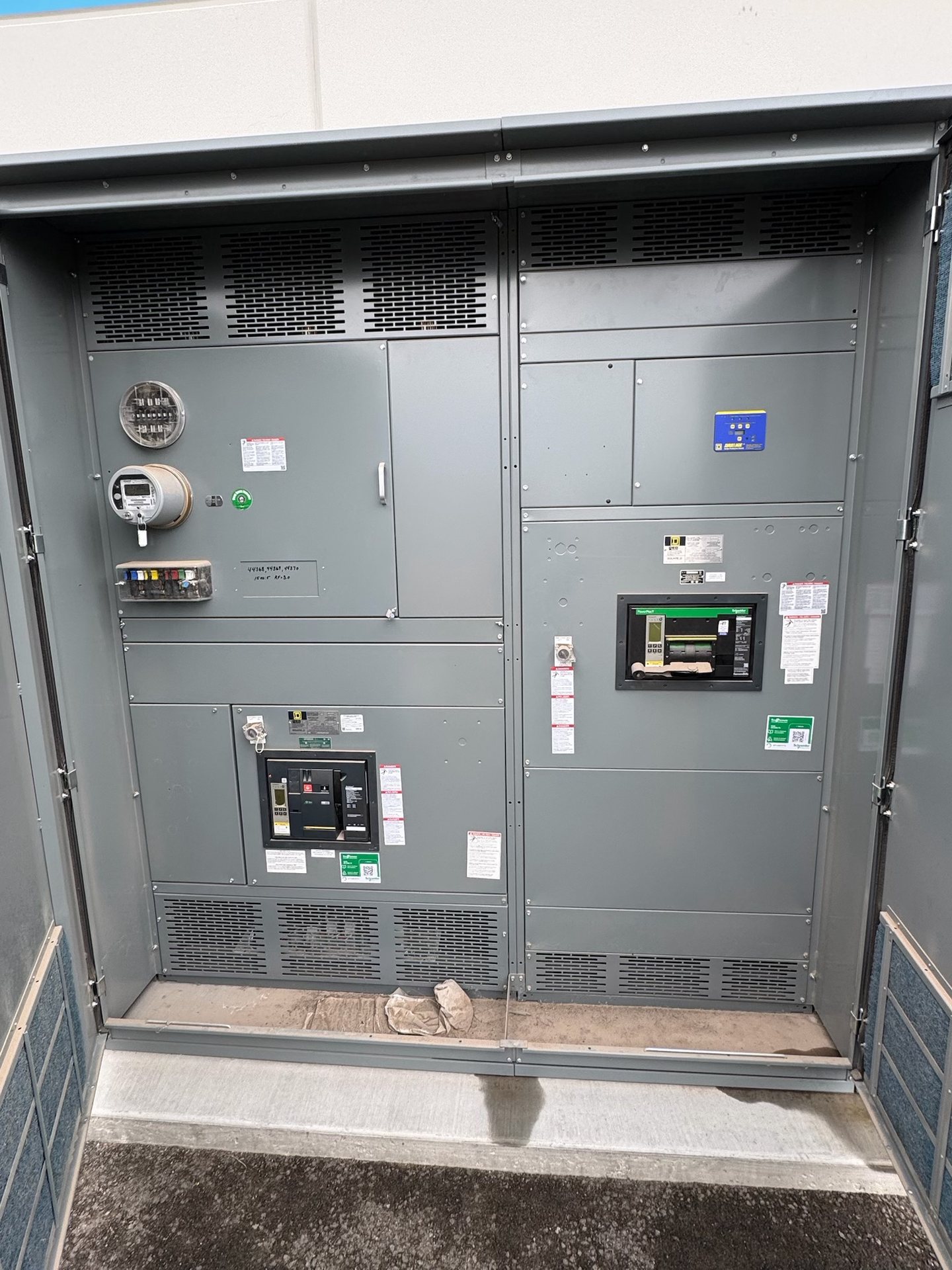
Define what the 800-amp rating applies to
Start by identifying whether 800 amps is the required rating of the main bus, a main circuit breaker, a feeder device, or another assembly component. Those ratings describe different parts of a distribution lineup and should not be treated as interchangeable. A bus rated for a particular current does not, by itself, establish the rating or suitability of every breaker, connection, or downstream circuit.
Provide the one-line diagram and indicate the intended equipment arrangement, main-device configuration, feeder count, and any future spaces or provisions. Confirm whether the 800-amp figure represents continuous operating demand, a specified equipment rating, or a project criterion subject to engineering review. Clear boundaries help us develop a configuration that reflects the design rather than an ampere value alone.
Match voltage and phase to the system
An 800-amp assembly must be designed for the electrical system it will serve. Specify nominal system voltage, phase, frequency, number of wires, and grounding arrangement, along with any relevant source or transfer configuration. Do not assume that two assemblies with the same current designation can serve the same system; voltage and system topology influence device selection, insulation requirements, bus arrangement, and connection details.
Include the project drawings that show the service or distribution point and identify whether the equipment connects to a transformer, generator, utility source, or another switchboard. If the project includes multiple sources or a transfer scheme, describe the intended operating modes and interconnection requirements. We review these inputs for the quoted configuration; availability, engineering, and applicable standards must be confirmed for each quotation.
Evaluate load profile and device coordination
The load connected to an 800-amp distribution assembly affects how its bus and protective devices should be specified. Provide a load schedule that distinguishes continuous and intermittent loads, major motor loads, and equipment with significant starting or inrush current. Include known operating patterns, anticipated load growth, and any critical loads that affect how the distribution system is arranged.
Identify the required main and feeder functions, protective-device types, and coordination objectives from the project design. The 800-amp label alone does not establish a breaker trip setting, feeder capacity, or protection scheme. Where selectivity or coordination is important, provide the available study criteria and related project documentation so the specified equipment can be reviewed alongside the system design by the responsible engineering team.
Provide fault-duty and system study information
Fault duty is a separate selection input from continuous current. The equipment must be evaluated against the available fault current at its point of installation and the protective-device characteristics specified for the system. Supply the available short-circuit current, source and transformer information, and any applicable coordination or arc-flash study documentation. If study values are pending, identify that status rather than substituting an assumed rating.
Tell us whether the project imposes requirements for short-circuit ratings, withstand capability, or specific protective-device combinations. These considerations depend on the complete proposed configuration and its application; an 800-amp current designation does not imply a particular fault rating or performance result. Applicable ratings, documentation, and standards should be verified during project review and stated in the quotation as appropriate.
Specify enclosure and installation conditions
Describe where the 800-amp equipment will be installed and what the enclosure must accommodate. Relevant inputs include indoor or outdoor placement, environmental exposure, available footprint, access and working-space constraints, cable entry direction, conduit locations, and connection requirements. Provide layout drawings or dimensions where available, and identify restrictions that could affect assembly depth, section arrangement, lifting, or placement at the site.
State the required enclosure type and any project-specific environmental or finish requirements rather than relying on a general description such as “weatherproof.” Confirm whether the installation is part of a new distribution system or a replacement within existing equipment. Interface dimensions and field conditions should be checked by the project team before fabrication; equipment suitability depends on the actual application and approved design documents.
Plan new equipment, retrofit scope, and procurement
We supply new equipment and new retrofit components only. For an 800-amp retrofit, provide existing equipment identification, nameplate information, internal and external photographs, relevant drawings, and the exact function of the replacement component. Confirm the equipment manufacturer and model, bus and connection details, available clearances, and the project’s acceptance criteria. A current rating by itself is not enough to establish physical or electrical compatibility.
For either a new assembly or a retrofit component, submit the desired scope, required documentation, requested schedule, delivery destination, and any project specifications that govern components or testing records. We build to specification using American components when specified; component origin and any domestic-content requirements must be confirmed for the quoted configuration. Requests for pricing are welcome, with availability, engineering, lead time, and documentation subject to project review. Installation, servicing, testing, and energization require qualified personnel following approved procedures.