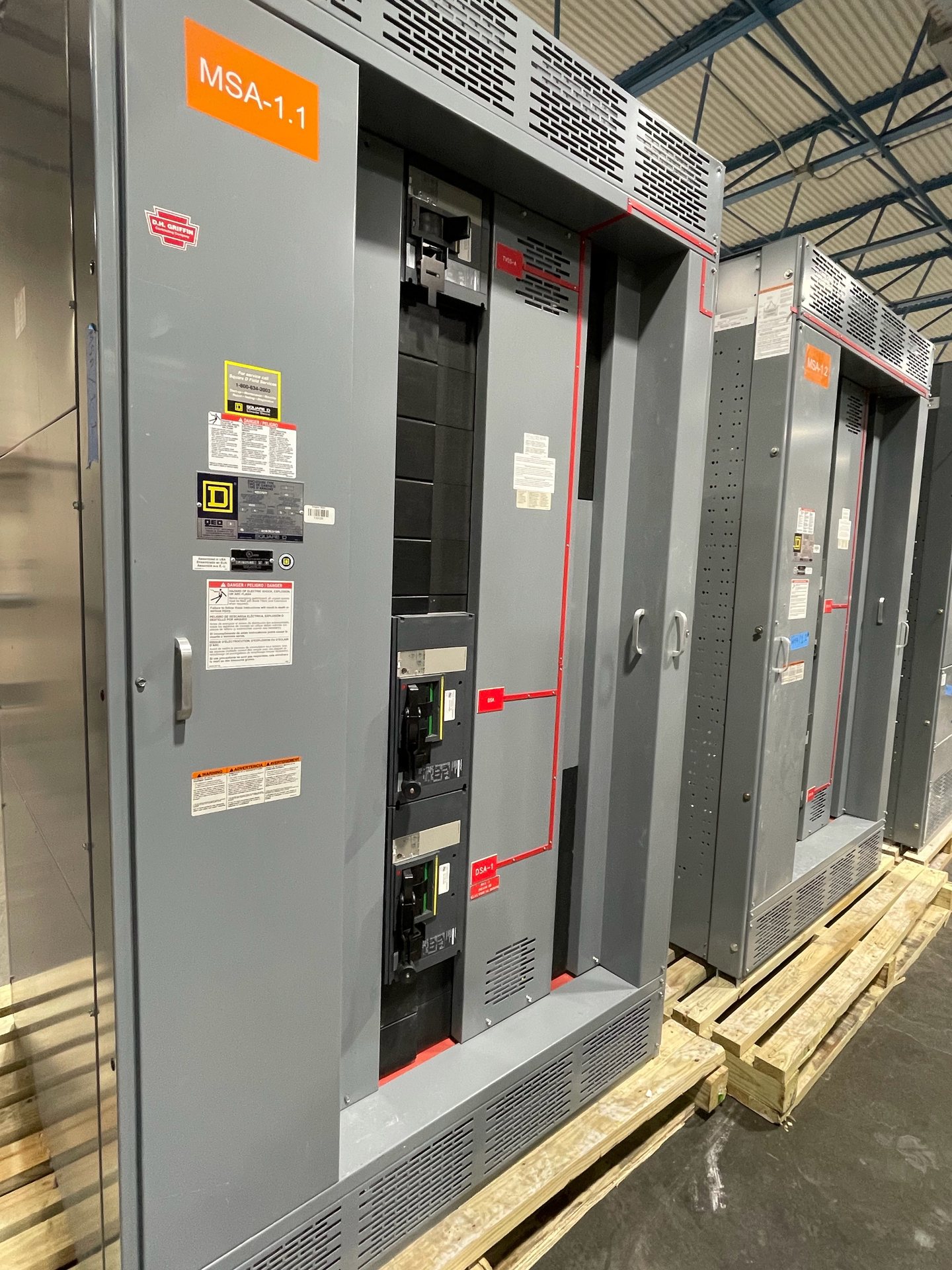
How switchgear differs from a panelboard
A panelboard is typically a compact assembly of busbars, overcurrent devices, and associated components that distributes power to branch circuits or downstream loads. Switchgear describes equipment arranged for switching, protection, control, and isolation of electrical circuits; its configuration can serve a broader or more demanding role in a distribution system. The terms do not identify equivalent products, and the equipment name alone does not establish the assembly’s ratings or capabilities.
Start with the single-line diagram and ask what the equipment must do: receive service power, distribute feeders, supply branch circuits, provide a means of isolation, or coordinate protection with upstream and downstream devices. Also establish voltage, continuous current, available fault current, grounding arrangement, and installation environment. Those inputs help the engineer determine whether a panelboard, switchboard, or a switchgear configuration is appropriate; the final selection must match the project’s design and applicable requirements.
Different roles in the distribution system
Panelboards commonly serve as downstream distribution points, organizing circuit protection for lighting, receptacles, equipment, or smaller feeders. Switchgear may be specified where the system requires coordinated switching and protection of larger feeders or sources, or where the operating plan calls for equipment arranged around particular isolation and control functions. These are general roles, not universal boundaries: actual application depends on the design, device selection, and equipment construction.
For a Texas project, share the service or feeder location in the one-line diagram, the loads served, and whether the assembly is intended for service entrance or downstream use. Identify the number and type of incoming and outgoing circuits, source arrangements, and any required future spaces. Avoid choosing by room name or a broad label such as “main electrical panel.” The engineer and manufacturer need the actual system function to develop a configuration that fits.
Protective devices and coordination
Both equipment categories can use protective devices, but the available device types, frame sizes, mounting arrangements, and operating features depend on the specific design. A panelboard may use branch-circuit breakers or other specified devices; a switchgear assembly may accommodate devices and compartment arrangements suited to its system role. Do not assume a device can be moved from one assembly to another simply because its current rating appears similar.
Protection must be evaluated across the system, not selected from a device label in isolation. Provide the available fault-current information, upstream protective-device data, downstream load requirements, and any coordination or arc-flash study criteria established by the project team. Ask which device types and adjustments are supported in the proposed configuration and what documentation is available for review. Settings, installation, testing, and energization belong to qualified personnel following approved project procedures.
Ratings and construction are configuration-specific
Switchgear and panelboards are offered in different construction and rating ranges, but a product category does not guarantee a particular voltage, current capacity, short-circuit capability, enclosure, or environmental suitability. The required values must be established from the system design and confirmed for the exact proposed assembly. Available ratings and component selections are subject to engineering and project review, so a page or category description is not a substitute for a quotation tied to the application.
When requesting pricing, identify the nominal system voltage, required continuous-current rating, fault-duty basis, neutral and ground requirements, enclosure conditions, and available space constraints. Include applicable service requirements, connection details, and any project standards. If the specification calls for American components, state that requirement and request confirmation of component origin for the quoted configuration. Component origin and documentation must be confirmed per quotation; this does not itself establish independent verification or compliance with domestic-content rules.
Maintenance access and operating arrangements
Maintenance planning differs with equipment construction and the devices installed. A panelboard’s access and service approach may be organized around its cabinet and branch devices, while a switchgear design may include other compartments, isolation provisions, or operating arrangements. Neither label guarantees that equipment can be maintained energized, that a device is withdrawable, or that replacement parts will fit. Confirm the exact construction and service clearances rather than inferring them from the equipment name.
Before finalizing the design, ask who will operate and maintain the assembly, what access and working space the room provides, and how the facility expects to isolate equipment for service. Clarify whether the project requires particular device access, interlocks, spare-device provisions, or replacement-component planning. Maintenance, inspection, testing, and servicing require qualified personnel using the equipment documentation and approved procedures. For retrofit work, verify the existing assembly identification and interfaces before specifying new replacement components.
Choosing new equipment or retrofit components
A replacement decision should begin with the existing equipment’s manufacturer, model, ratings, device catalog information, and physical arrangement—not with the assumption that a panelboard or switchgear component is universally compatible. For a retrofit, document bus and connection details, available compartment or mounting space, control interfaces, and the intended protective function. The manufacturer must review these details to determine whether a new retrofit component can be specified for the existing assembly.
Switchgear Builders Texas manufactures new equipment to specification and supplies new retrofit components. For a new assembly or retrofit request, provide drawings, the equipment nameplate data, schedules, technical specifications, and the project’s required delivery window. We review scope, configuration, component availability, lead time, and documentation for each quotation. UL 891 applies to switchboards; verify the applicable standard and any listing requirements for the exact equipment configuration rather than assuming they apply across product categories.